
Before we dive into this, let’s first remember these key supremacist, insurrectionist things Jesus said (and this is just the tip of the iceberg as we are not counting Revelation or Christ’s voice in the Old Testament as the false brutal murder “god” Yahweh):
- “I did not come to bring peace, but a sword.” Matt. 10:34
- “I was sent only to the lost sheep of Israel.” Matt. 15:24
- “But those enemies of mine who did not want me to be king over them—bring them here and kill them in front of me.” Luke 19:27
- “When you pray, don’t babble like the Gentiles, since they imagine they’ll be heard for their many words.” Matt. 6:7
- “Let the children first be filled: for it is not meet to take the children’s bread, and to cast it unto the [Gentile] dogs.” Mark 7:27
- “Give not that which is holy unto the dogs, neither cast ye your pearls before swine, lest they trample them under their feet, and turn again and rend you.” Matt. 7:6
- “Verily I say unto you, There be some standing here, which shall not taste of death, till they see the Son of man coming in his kingdom.” Matt. 16:28 <— FALSE PROPHECY
- “Therefore do not be anxious, saying, ‘What shall we eat?’ or ‘What shall we drink?’ or ‘What shall we wear?’ For the Gentiles seek after all these things, and your heavenly Father knows that you need them all.” Matt. 6:31-32
- “And they shall fall by the edge of the sword, and shall be led away captive into all nations: and Jerusalem shall be trodden down of the Gentiles, until the times of the Gentiles be fulfilled.” Luke 21:24
- “If any man come to me, and hate not his father, and mother, and wife, and children, and brethren, and sisters, yea, and his own life also, he cannot be my disciple.” Luke 14:26 <— OBVIOUS CULT LEADER TALK
Here is a VERY IMPORTANT NOTE. The above statements are direct, Biblical statements from the Jesus character. This character also fully supported the prophecies of Isaiah, etc., which prophesied the literal death and slavery of all Gentiles to the Jews (the parallel prophecy is in the book of Revelation). According to this supremacist Jew, we will “lick the dust” of Zionist feet, just because of our ethnicity as Gentiles. It is a full-on prophecy from God, according to Christians. But the main point is this: If I say I love murder, but then the next day say: “Actually, no I don’t,” it does not make me good. Just because the character is sometimes shown saying a paltry few “pro-Gentile” things, it does not even come close to outweighing the evil, or doing anything other than demonstrating a psychotic or schizophrenic contradiction. If I kill a bunch of babies like Jesus/Yahweh, and then later call myself loving to all, who gives a fuck??? Logically it does not matter at all.
Galilean Insurrectionism
1st-century Judea was a hotbed of radical resistance to Roman rule. Insurrectionists claiming to be the Messiah or even the “Son of God” seem to have been a dime-a-dozen, with Galilee as the historical center of this anti-Roman-state plotting, conspiracy, and activism. Extrabiblical sources document this historical reality well, and note that many figures were attempting to install a very real Jewish king in a very real Jerusalem — far from some mere spiritual “kingdom of God” metaphor for the distant future. This is why Christ told his followers even in the Bible that “some standing here” would not even die or taste death at all before they saw him coming in his kingdom. Why would he say that if it applied to some distant, spiritualized future? I have seen no good, honest answer for this.
What may be most surprising to some people (Christian and non-Christian alike), is that the Bible itself attests to the reality of this insurrectionist culture of the times on multiple occasions. Jesus’ death sentence especially attests to this. He was not stoned to death for blasphemy under Jewish law. He was crucified — a death sentence meted out to thousands of others by the Romans — for claiming to be “King of the Jews.” In other words, it was a political offense. The Romans claimed that title, “King of the Jews,” and rightly viewed Messianic claimants as insurrectionists. This isn’t to say the Roman empire was “good,” just to denote a factual reality.
Christ’s contradictions in word and action (“He that hath no sword, let him sell his garment, and buy one” / “All they that take the sword shall perish with the sword”), and Gospel contradictions, finally start to make sense when we view the Christ character through this historical — and Biblical — lens of historic insurrectionism, and as the perpetrator of supremacist-cult-leader con games for power.
Let’s start by talking about the 1st-century insurrectionist Judas of Galilee, as this will illuminate a lot of things.
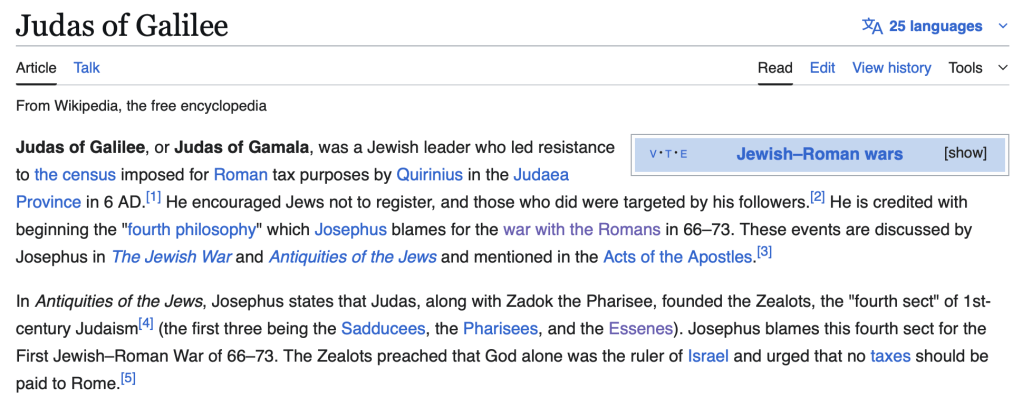
Please note that though the above is a mere Wikipedia article, the original sources are cited, such as Flavius Josephus describing the fourth sect of 1st-century Judaism in his Antiquities Book 18, Chapter 1. Also note that the insurrectionism of the day and its effects are mentioned in the Bible. This is not up for debate, but is historical fact, and Biblical text. Even one of Jesus’ disciples, Simon, is four times called “the Zealot” (the Zealots were a hardcore group of insurrectionists) in the Christian Bible.
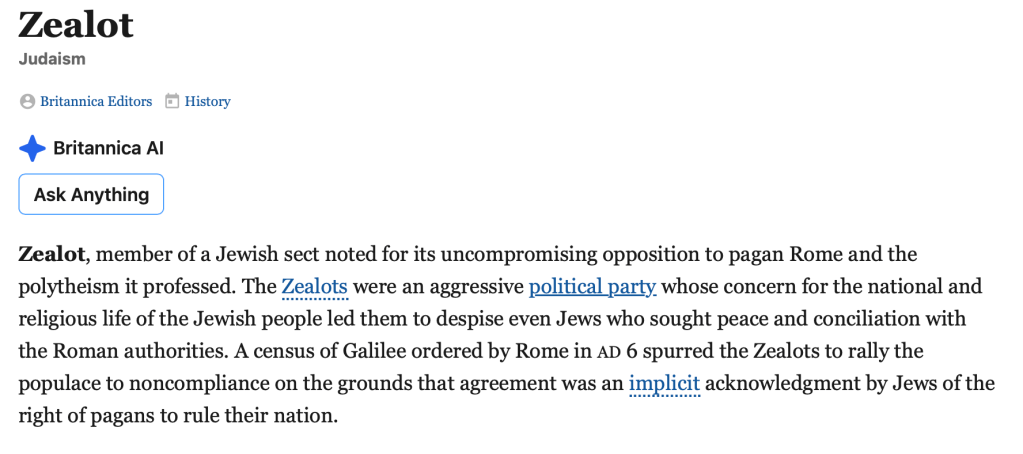
Scholars and apologists may debate whether this means he was a political rabble-rouser or simply “on fire for God” (as modern Christians say), but the latter assertion seems kind of weak in light of historical fact and the overwhelming Biblical evidence obtained by reading for context.
It is likely that the Christ character of the Bible was an Essene and/or later on, a fourth sect adherent, and we find clues about this in Josephus’ writing: But of the fourth sect of Jewish philosophy, Judas the Galilean was the author. These men agree in all other things with the Pharisaic notions; but they have an inviolable attachment to liberty, and say that God is to be their only Ruler and Lord. They also do not value dying any kinds of death, nor indeed do they heed the deaths of their relations and friends, nor can any such fear make them call any man lord.
Let’s pause there. They do not heed the deaths of their relations and friends, according to Josephus. This reminds me of the words of Jesus to the poor guy that just wanted to bury his dad: “Let the dead bury their dead: but go thou and preach the kingdom of God.” Here’s another verse which is evidence of this disregard for family: “If any man come to me, and hate not his father, and mother, and wife, and children, and brethren, and sisters, yea, and his own life also, he cannot be my disciple.”
Another interesting bit of history about the Essenes: “No one possesses a house absolutely his own, one which does not at the same time belong to all; for in addition to living together in companies [“ḥaburot”] their houses are open also to their adherents coming from other quarters [comp. Aboti. 5].
Have you ever wondered how Jesus’ disciples could just wander from town to town and be accepted into the homes of “strangers”? The Essenes had a vast network of support.
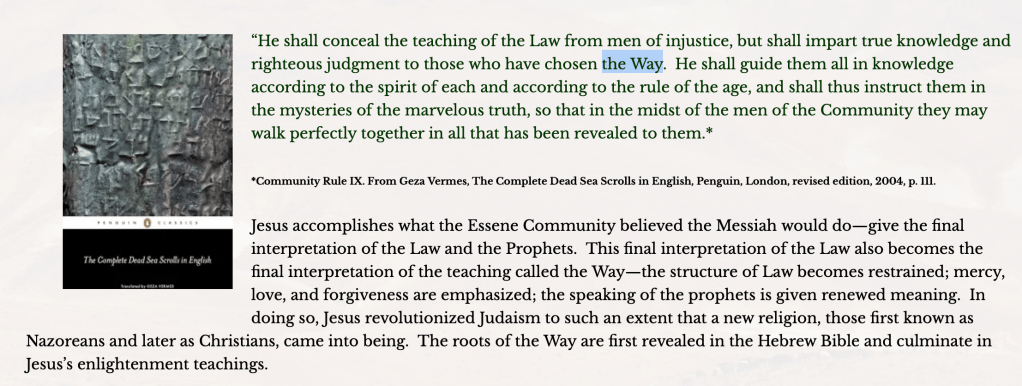
The Essenes lived in the wilderness, practiced baptism/ritual purification in water long before the advent of Christianity, and forsook the company of society and women. Sounds a lot like John the Baptist. Essenism was also known as “the Way” as evidenced by the Dead Sea Scrolls. This idea of the “Way” as a sect is also found in the Bible. Please read the screenshot below carefully. Here is the link.
Now let’s look at what that supposedly converted, radical persecutor of competing Jewish sects, Paul, had to say while defending himself in the book of Acts in the Christian Bible:
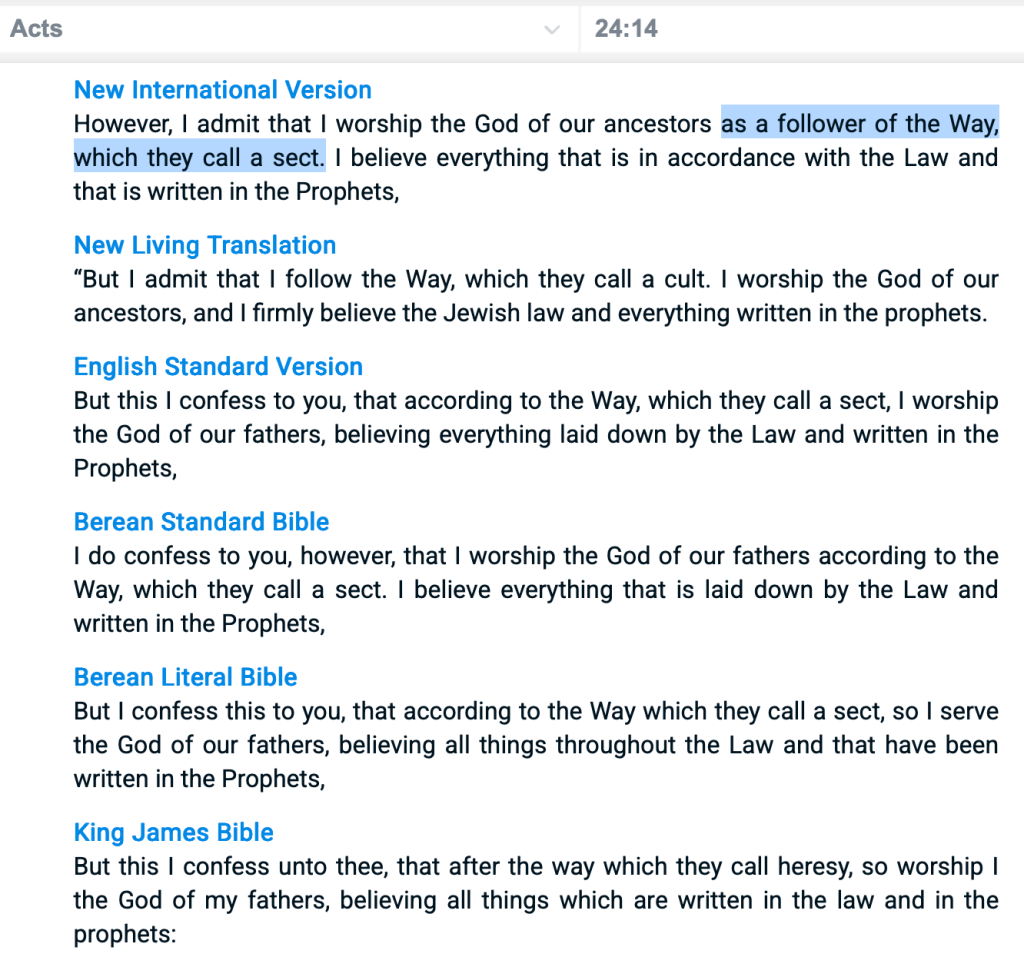
This means Paul believes what is written in Isaiah. All the terrible murder and slavery and theft from “Gentiles” that is prescribed. Jesus, too. And he identifies with a sect called “The Way.”
Well, until Part II, here are some links to peruse in preparation, I guess.
https://www.biblicalcyclopedia.com/C/chrestus.html
https://earlychristianwritings.com/suetonius.html#google_vignette


 Voluntary Japan
Leave a comment