

I typically don’t like to use generational labels in a negative way, as any blanket label never accurately represents a group of individuals. And I am not even saying the gaslighting I’ll be talking about is always intentional. However, the damage is real, and there are definite patterns I have noticed with this generation, the “Baby Boomers,” refusing to try and understand younger generations, and the economic situations (I don’t agree with everything in this linked video, by the way, but it is worth a watch, and much of it is right on) and hardships we face, among other, more emotional and mental struggles. And, as this generational mud-slinging has indeed been used on me by my own father (who now doesn’t want to communicate with me) when I was still just a teenager — as he dismissed our inability to connect (though I was trying) as a “generation gap” — I don’t feel I am too amiss in not pulling many punches here. This whole thing was never about aggression or social media trends, mere politics, or being “entitled,” and I have sought, at exhaustive length, to mend fences, but to no avail.
So, to the meat of the matter:
Christianity is a self-destructive, financially toxic belief system.
It advocates recklessness with money, poverty, and a mindset that cares not at all for the future. And to make things worse, the very individuals endlessly vexing and shaming us for not following Jesus, themselves habitually refuse to obey his simplest and most clear commands about money. The video below lays out the argument almost perfectly. Please, do watch it. It is critical in understanding how Christians gaslight others into losing their money, while they themselves never actually follow their own advice, or that of their Bible. Prior to watching this video, I had already tried to raise these same points with my parents.
***
SEE THE VIDEO HERE, MUST WATCH!: https://www.youtube.com/watch?v=yr4T_8lvnMc
***
ME: Jesus said to give away all you have, or you cannot be my disciple.
PARENT: Well, he didn’t mean it that way.
ME: But there’s no caveat, and you are not supposed to add your own interpretation to the Bible.
PARENT: Well, we have to be sensible.
ME: But he didn’t say anything about being sensible. He said don’t worry about tomorrow at all.
PARENT: Well, we know he didn’t really mean that.
ME: Huh?
What infuriates me most about Christians is that 99.9% of them refuse to acknowledge the very book they profess to believe, and what it clearly says. Christ advises to “keep my commandments” and then, in the Great Commission, so-called, tells his disciples to teach others — all nations — all throughout the world to do the same, to keep his commandments.
So, I took belief in Jesus and the Bible seriously, and it seriously devastated my life financially.
I tried to discuss this with my parents about 6 months ago now, but they don’t want to have a serious conversation about it. And before I am accused of blaming and shaming, no, no, no, no. I take full, 100% responsibility for myself and fixing my situation. But I do lay blame where it belongs.
Had I not been taught that I was literally evil, that I must always consider others better than me, that I must not ever worry about tomorrow as Jesus commanded, that I must give away all I have to follow Jesus, and that money is evil, I would NOT be where I am today — barely stringing the months together in perpetual, nauseating anxiety of endless debt and lack. A debt and lack compounded severely by the current economic situation, based on massively inflated, devalued fiat currencies, where young people cannot even afford homes or to have children anymore, while the Boomer generation tells us to just stop drinking coffee and work harder. Or that they’re “praying” for us. I want to warn others, and speak out against this nasty cult. So, Let’s look at a few passages, and put the gaslighting to rest:
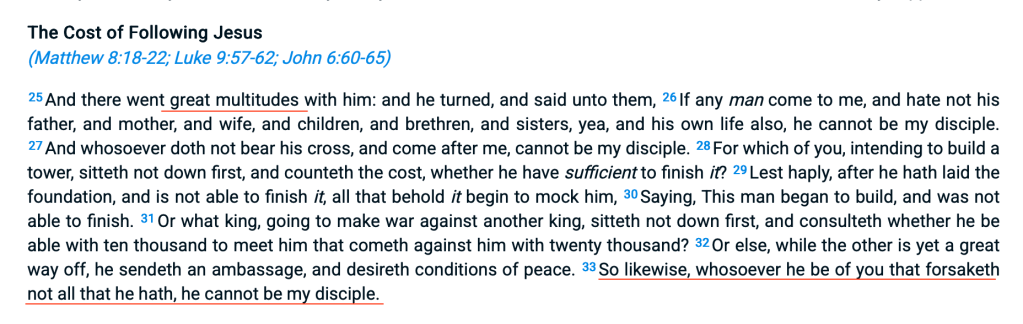
In the above passage, Jesus is talking to “multitudes.” This means the commands he makes here are not just for his disciples, etc., but for everyone. Aside from having to hate your family, one must also forsake all they have, or, as Jesus says, you “cannot be my disciple.” Please note, then, that in the Great Commission, where he is telling his disciples to teach all nations the same things he commanded them (to “observe all things whatsoever I have commanded you”), this would include the command pictured above, to forsake everything. Forsaking all you have means giving away and giving up all of your possessions, just as the first church did, as is also documented in the Bible’s book of Acts (more on that shortly).
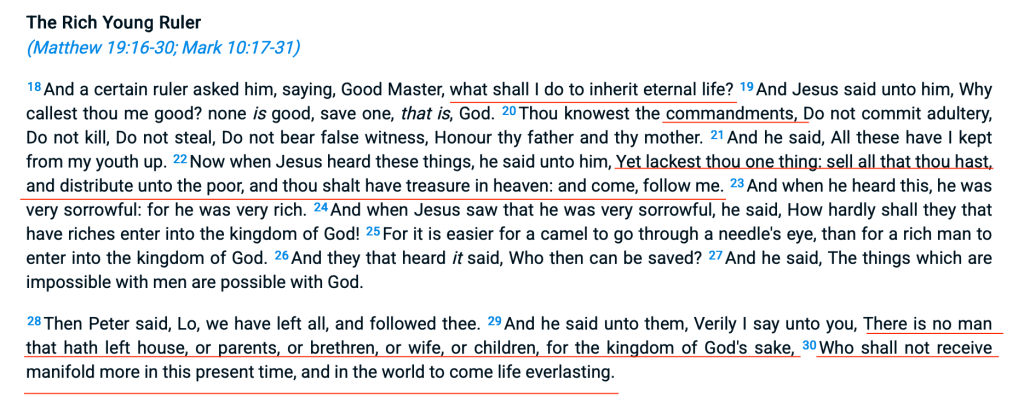
There’s so much to address in this one. Another direct command. This time more or less explicitly classified as such. Again, we have the messiah figure saying that, in addition to the famous Ten Commandments (yes, Jesus says you must follow those, too! in Matthew 5:17-19, as heaven and earth are still here), there is one more command the rich ruler must assent to: “sell all that thou hast and distribute to the poor…”
Here we again see talk as well about forsaking one’s own family, and even receiving riches in the present time, on earth, not just in heaven. This only makes sense when viewed in the correct context. After all, why would people need to abandon their families to go around Judea just helping people and healing and praying for them? This is about insurrection. As when Jesus told his followers over 2,000 years ago that some of them would not even die before they saw his glorious return with angels, to judge the whole world, here he is again talking about the impending overthrow of Rome, via insurrection (which was extremely common in 1st century Judea historically, as were actual, historical insurrectionists that the psyop Christ character is based on), and the spoils that could come with it.
But because even present-time spoils, understandably, wouldn’t be enough to convince everyone to abandon their families like trash and risk their lives for him, he promises riches in the afterlife even if they die.
The main point is, though (excuse the above tangent): There are almost no Christians today that follow these commandments. Maybe even none. They simply insert their own interpretations on top of the clearly objective passages. This is forbidden by the Bible, by the way (See: Proverbs 3:5, Revelation 22:18).
And to top all of this off, what do we see the earliest churches doing in the Bible? Selling and giving away all they had and holding all things “in common”:
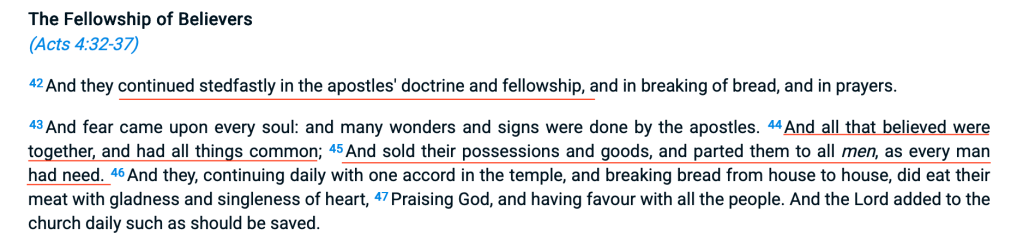
Hell, poor old Ananias (who was probably actually in on the scam, or at least the story of him is there for the purposes of the ongoing scam) was struck dead in front of the congregation by god for holding back some of the proceeds from the land he had sold. And then his wife was whacked by the “holy spirit,” too. But when you ask Christians why they don’t live like this today, or why there are still impoverished people in their communities, they have no good answer. Now, don’t get me wrong. I don’t want anyone to live like this! Giving away all you have means you won’t be able to help anyone, and we’ll all be poor, with only the elitist leaders of society managing all of the funds. Hmmmm. It’s starting to sound a bit like something that Klaus Schwab fellow might like, isn’t it? (Please really think about that. There’s a reason this philosophy is all over and in and throughout the pages of the “holy book” of the most popular religion on the planet. One that also says Zionists are the universe’s “chosen” people. Phew.)
But I digress, again. If you’ve read this far I congratulate you. I am probably trying too hard to say it all at once. Suffice it to say, I didn’t want to force my parents to change their beliefs. I didn’t want to shame them. But I did want some accountability and honesty. Some real repair, and a willingness to say “I don’t know why that’s in the Bible. You’re right, it doesn’t really seem to make sense. I don’t why we don’t follow those commands, either. I still believe in my religion, but your frustration and questions are logical and valid.” These would have been loving, compassionate, down-to-earth, human responses. Instead, when I reached out and said how black things were looking financially, and how much I was struggling because of the teachings of this book that I took so much more seriously than they did (because they told me too and even physically beat it into me), all I get is cheap excuses. And more blame. As if I am illiterate, or hateful, or both, for reading direct commands from Jesus and wondering why Christians don’t follow them. For seeing what these commands did to my life — how much precious time and resources I lost and irrevocable opportunities of youth I lost, and how many poor decisions I made because of them — and waking up in the rubble at 41 years old.
Well, I’ve not given up. Slowly but (un)surely I am trying to claw out of the pit and finally follow the Jewish “messiah’s” advice: Don’t build your house on the sand. Build it on a solid foundation of rock. Yes, exactly. And that rock is reality, not some fourth-rate Jewish fairytale that destroys the lives of those who follow it.

